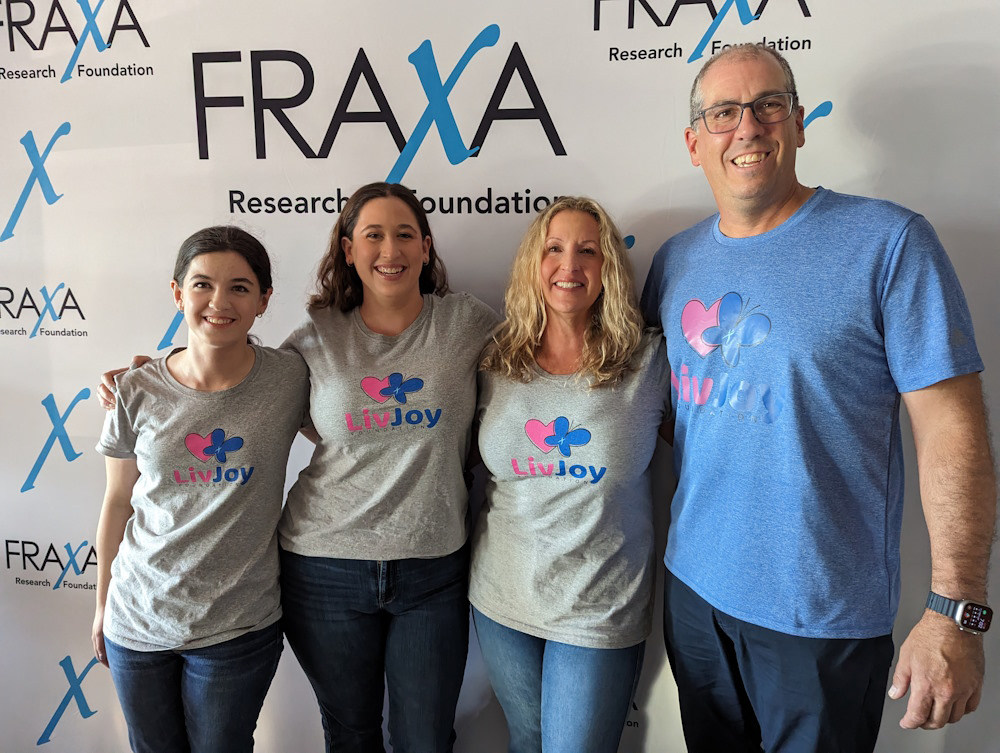
LivJoy fellowship supports post-doctoral research
Early testing is imperative in the first step of treatment for any disorder – the sooner testing is performed and symptoms are given a name, the sooner and easier it will be for patients and caregivers to access support and finally have answers to their questions.
But what happens when there isn’t even enough data to provide those early tests?
Fragile X Syndrome (FXS) is the most common inherited cause of intellectual disabilities and intellectual impairment. It is caused by a gene in DNA not producing a certain protein important for neurological development and brain function. Though found in both sexes, research on how it affects males vastly outnumbers female-centered studies, a void that leaves thousands of families in the dark on how to help the girls and women in their lives that may be affected.
Diagnosis of females with FXS is severely underreported because their symptoms often manifest differently from men’s. Since one cannot find what one is not looking for, many women go undiagnosed and cannot access the programs, education, treatment and research necessary for them to live “a life full of joy.”
The LivJoy Foundation, founded by Rachel and Brian Clouse, seeks to build awareness, support advocacy, promote services and programs and fund medical research for females with FXS. Named after their daughters Livia and Amanda Joy, both of whom have been diagnosed with FXS, the Foundation partners with many organizations focused on quality-of-life improvements for those affected. It has also partnered with the University of South Carolina’s Arnold School of Public Health to fund a postdoctoral fellowship grant to fill in the “knowledge gap” of female data.
The fellow in question is Lauren Jenner, who, after earning her Ph.D. in psychology, has made this undertaking her life’s work.
“I’ve always wanted to look at genetic syndromes, but I really wanted to study an underrepresented group,” she says.
Jenner’s research attempts to describe the lived experiences of mothers with FXS, who are often raising children who have been diagnosed with the syndrome. Her soon-to-be-published academic paper reviews the psychiatric difficulties in females with FXS. She hopes her publication and current research will make long-term contributions to the field of study itself.
“The fact that this grant is being funded by a family makes it so much more personal, and it makes you think about the research in a way where you’re asking these families, ‘What’s important to them?’” Jenner says. “Actually having data from interviews, and being able to start from a person-centered perspective, has been very helpful.”
The Foundation’s goal of more female representation in Fragile X research resonated with Jenner, who works closely with Jessica Klusek, an associate professor of Communication Sciences and Disorders in the Arnold School. Klusek knows from her own research that getting started is the hardest part: qualifying for external funding is difficult unless there is already a certain amount of initial data and published, peer-reviewed studies. Research is impossible without funding, but funding is impossible to secure without research. It’s a cycle The LivJoy Foundation is breaking with this fellowship grant.
“You need a little bit of support to get started so you can develop that and then pursue larger funding,” Klusek says. “I think that’s the reason why there’s not a lot of research on females with the syndrome, because you need that initial investment.”
The fellowship funds a stipend for conferences and added measures to existing testing procedures. Though Jenner is only one person, and the subject matter is niche, her work could have a massive impact on the studies of females with FXS – the exact goal the Foundation is trying to achieve.
“Without a doubt, we could not do this without the support of The LivJoy Foundation,” Klusek says. “It’s a small field, so even having just one person who’s knowledgeable makes a big difference. It’s very meaningful, and we’re very grateful for their investment and trust in us.”